Showing posts with label dressage training. Show all posts

3.3.20

Equestrian self-confidence

Riders often criticise themselves when things don’t go to plan and many others frequently doubt their  own ability. Whenever I've taught riders giving them more confidence and belief in themselves has always been the thing that I've worked hardest on, because it's always been the one that they needed most support for. I've heard so many people wondering if they’re doing their horse justice, if they’re making the people who support them proud, if they’re really a good enough rider to achieve their goals 💫 Often this leads to perfectionism, overthinking or over-riding... Does this sound familiar? If so, you’re not alone! I wanted to share with you how to develop your self-confidence/self-belief, because I know so many riders who aren’t pursuing their dreams because of self limiting beliefs and their fear of the judgment, defeat or embarrassment - and I do include myself in this group. Why do you think it's taken me YEARS to get back out competing again? Out of fear of the judgement of others and from crippling attacks on my self-confidence. It's a feeling I know so well.
Essentially, there are two elements that affect your riding confidence: the technical skill/your ability and the mental skill/your mindset. Have you ever seen a less technically skilled rider get better results than someone with more skill at a competition? I've seen it a lot! Whilst it can be due to a lot of reasons, it could also be because your mindset is so incredibly important. And here I have point out that self-confidence is not something that you inherently have or don’t have! Self confidence has nothing to do with talent. Self-confidence and self-belief come from hard work and from your willingness to experience vulnerability. It comes from your willingness to experience judgment from other people, failure and embarrassment at a show, at a clinic or at your yard. Which is why the more you go out, whether it be competing or training, the less nerve wracking it becomes as you get used to it. 

7.1.20

The trouble with travers

Travers (also known as haunches-in) is one of those movements that I hardly ever ride, and I know I really should ride it more often but for some reason I've never really liked the movement. I first learnt about it with Basse when I was having lessons to try to help him to learn half pass, as this movement is often used in schooling as a way to prep the horse for teaching them half-pass but it's never been one of my favourites to ride.
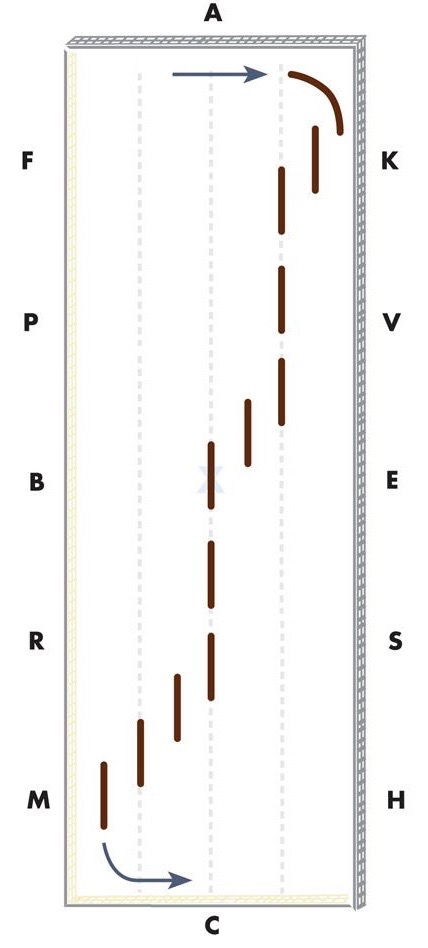
 So let's just recap what travers really is - when riding this movement the horse is asked to bring their hindquarters to the inside of the line they're being ridden on, whilst maintaining bend through the poll, neck and body in the direction of travel. So essentially, if you're riding this on the long side of the arena the horses bum is 'in' and the rest of their body is still on the long side. You can ride it on any line and it is particularly useful for communicating to the horse the meaning of your inside and outside legs. If you really want to challenge yourself and your horse, ride travers on the 3/4 line and if you can get it perfect you know your travers is in fine shape! 🐴

27.11.19

Riding exercise of the month: trot-halt-rein back-trot

Every winter when the clocks go back and it gets darker earlier and earlier, I always go through a few weeks of experiencing a persistent grumpy mood, a loss of interest in just about everything and constantly feeling lethargic and sleepy during the day - I wouldn't say that it's seasonal affective disorder since it only lasts for a few weeks but I do think it's the winter blues hitting me hard. But now that a few weeks have passed and I've started feeling better and more like myself again - it's time for one of my favourite riding exercises, the trot-halt-rein back-trot!
The trot-halt-rein back-trot is a fabulous exercise for creating a quick burst of engagement in your horse’s movement. I was taught this in one of my lessons with Andrew Fletcher years ago with Vallu and it's one of those exercises that I always go back to whenever I need a little bit more oomph from the horses. It's a great chance to practice getting sharp responses from your horse, especially for getting them to think more quickly. Obviously first do your normal warm up, and then once you're ready find a nice rhythmical trot. When you feel like your horse is ready, ask for a prompt halt. Make sure you are not pulling back on the reins to halt. When the horse stands still, ask for  3-4 steps rein back and then go forward into a trot from the rein back. And repeat again, again and again until it feels good. The repetitions that you do within this exercise allows the horse to naturally improve each time, because they can start to anticipate what comes next. 

29.8.19

Riding exercise of the month: collected to extended transitions

This is one of my favorite exercises for developing great collected-extended-collected transitions. It's a very simple exercise that rewards your horse for beginning to explore their abilities that might be outside of their normal range - so that you can teach your horse that they can extend more! In this exercise, you're able to really focus on your position to maintain your softness and flexibility, but it also allows you to focus on those aids that help flow through the horse's back to maintain the looseness that keeps the energy thats needed for those extensions flowing.
Start out in working trot, go down the long side of the arena and at the last letter before the corner of the arena, ride a transition to collected walk and ride a walk half pirouette so that you can then ride back down the same long side. Using the lightest-possible aids, straighten your horse and transition back to the working trot. Before you get to the corner, transition to walk and make half a walk pirouette in the other direction. Once you're back on the long side, promptly back into trot and each time that you repeat the exercise, ask for more each time during the trot on the long side.

9.4.19

Equilab app review

You might have seen quite a bit about an equestrian app called Equilab floating about whenever you've been on Facebook and Instagram especially now that spring is here and the hacking season has officially started, as the app is gaining more and more popularity in the UK. Created in Sweden, this app utilises artificial intelligence to help capture the movement of the rider and the horse, and whilst it tracks your hacking routes it also tracks everything from the time spent in each pace and turn distribution to the intensity of stride - great for any rider who wants the chance to be able to analyse their rides better! 🤓
I've recently been trying out the Equilab app, it's very in depth and has lots of options and fortunately it is available both on Android and iPhone. All you have to do is to simply turn on the app and put it in your pocket whilst you're out hacking or riding - although for the first few days I totally forgot to have my phone on me as I never used to have my phone with me when riding. If you're like me, it only takes a few days to remember to take your phone with you, then it becomes an automatic thing! I find it very useful to see how I'm riding - I can tell how many turns I've done, whether I'm favouring one rein over the other, as well as my rhythm and elevation.  It's great when you don't regularly have lessons but want to be able to track your rides and evaluate how your rides have been going.
On the app itself you can set up your own profile as well as your horses' profiles, with the horse profiles being a little more in depth than the rider's. You are able to add a photo, the horse's name and nickname, the main discipline they do, their breed, weight and date of birth, as well as add multiple riders to each horse - so if two of you are sharing a horse it doesn't matter as Equilab has you sorted! I think this is a great feature that has been really well thought out, as not every horse has just one rider. I know several people who horse share and this app would be perfect for them as you can just open the app and see what they've been up to on the days that you've not been riding.

26.3.19

Arena hire & first trip out in the new trailer

With the arrival of our new trailer last week, on Saturday we went on our first trip in it to our local indoor arena. Getting there was a bit of an ordeal, as although we'd practised loading and unloading the night before, for some reason Erik decided that he didn't want to go on the trailer with Rama already being inside. After several attempts, we decided to try again so that Erik would go on first, and this time he loaded on the second attempt! Such a relief, I hate the struggle of loading an unhappy horse so it was good that we found out that he prefers to load on first. Luckily the place is less than 5 minutes away, so Erik and Rama didn't have to be in the trailer for a long time which meant that it was a nice first trip for them!
 All I wanted to work on was something easy for us both, so that we could have a nice and easy time on our first outing. I didn't want to work on anything difficult or frustrating, so transitions it was! I believe transitions are a key part of the horse's education - no matter how experienced your horse is. So I focused on getting good transitions both within and between paces. Riding forwards down the long sides of the arena and collecting at the short sides. The more I did this the more I could feel Erik becoming more supple in his body, but also more responsive and reactive to my aids 👏🏻 But then he has started to think it would be fun if he didn't slow down for the short sides as going forwards and fast is much more exciting, so I started varying where I asked for transitions and what I asked for (not just collected canter to medium canter, added in canter to trot and a few canter to walks), as this kept him focused on me and what is going to happen next, rather just doing a medium canter around the arena!

11.3.19

Riding exercise of the month: halt to trot

As the spring/summer competition season starts to get closer and closer, I've been working on several exercises to polish up to the look of our tests and to make sure we get the best possible marks. As halt to trot transitions are asked for at the beginning of most dressage tests, it's the first movement to get marked and you really want to make a good first impression to the judge! If you ride a good halt which is followed by a smooth and straight transition into trot, you set yourself up to get good marks in the rest of the test. And even if you're not competing, halt to trot transitions are useful as a riding exercise to make your horse sharper to your leg aids and to encourage them to step underneath more! 
When I start riding direct halt to trot transitions, I find it very helpful to position my horses along the fence line rather than on the centre line as this makes it easier for me to keep them straight during the halt and the transition to trot. Apply both legs on the girth with a small squeeze to ask your horse to move directly into trot - at first you might have to use a sharper kick or a tap with your whip if you don’t get a reaction, but remember to praise lots when the horse does what you want. Positive praise gets you quicker results that negativity! ❤️ Obviously the strength of the leg aid depends on the horse - a sharp horse will need less leg than a lazy one, but after training this exercise your horse should move into trot from the smallest of aids 💪🏻

28.1.19

Winter riding motivation

I'm quick to admit that I am very much a fair weather rider, which has only been fuelled on by the fact that for the last TEN years of my life I've always had an indoor arena either on the yard we were at or close by. So having to deal with the British winter weather (rain, gusty winds, showers, rain, wind, blinding sunshine and then some more rain) it's been a bit of an adjustment not only for myself, but also for the ponies 🌧💨 I always used to be a "I'll ride in any weather - if there is an indoor" kind of person, but now with no indoor arena near us, it's turned into "I'll ride in most weathers, but torrential rain and wind means a day off" kinda person. Although some people will tell me to man up and get on with it, I don't think riding my horses in terrible conditions with both the horse and I in a horrible mood is the right choice, so often the crappy weather days are for lunging, in hand work or a massage and grooming day. But anyway, here are my tips for creating as much motivation as possible for riding even on those miserable days ⤵️
1. Invest in warm clothes, gilets and shower-proof coats: Layers, layers, layers. My tactic for not only in the cold, but also for riding in the rain too as normally you won't get soaked through to the bottom layer. The more comfortable you know you will be, the more likely you are to follow through - even in miserable weather! So invest in those lined riding breeches (Pikeur FTW!), three pairs of gloves and several sweatshirts and jumpers that you can change as soon as you are done riding. My Rydale gilet is my favourite go to on dry but cold days and my current favourite knitted jumpers are from Rydale, sweatshirts from H&M and sweatshirts with motivational quotes on from Olco Equestrian 💞

16.9.18

Riding exercise of the month: transitions in lateral movements

I recently saw this floating about on Facebook again and this picture really caught my eye and inspired me for this month's riding exercise! ⤵️ I use most of these movements in my every day riding, just because it really helps to achieve a much straighter horse in comparison to just riding around aimlessly and adding in a few oddly shaped circles here and there. 
I often warm up in walk using shoulder in, travers, leg yield and half pass on all of my horses. It's a super easy way of suppling them and getting them to actually pay attention to me, which I've found to really help to achieve a better schooling session. Once I've warmed up in walk, I've been adding in trot-walk-trot transitions down the long sides whilst doing any of the lateral movements. It really is not as easy as it sounds! 😬 It's a big brain work out for both you and the horse, but it also helps with all of the other work. With Erik, the biggest difference that I've noticed has been that a straighter and more supple horse is not only an easier horse to ride (obvious much!) but also that we get much better flying changes! For a horse that is long and a bit slow, trot-walk-trot transitions down the long side whilst doing shoulder in and travers has been the best idea ever 💡

13.4.18

Riding exercise of the month: control the tempo of your flying changes

Whilst I've been riding my new horse Erkki for the last month now, I've been having fun trying to build up his strength in the canter and especially his flying changes. He has a tendency to rush through the changes if he's doing them across a diagonal, so I've had to get creative and think of ways that I can get him to slow down just a bit and start to listen to my aids and doing the change when I ask him rather than guessing when I'd like them!
The only thing that has really worked well with him has been to practise flying changes on a 20m circle! So if you're riding a circle at the middle of the arena, each time you get to the long side you ask for a flying change (so change at the E and B markers) and if after a couple of repetitions the horse starts to guess and take over, then start asking for the changes when you cross the centreline (so change at I and L if you're riding on 20x60 arena). By alternating where I've asked for the change, he's not had the chance to take over and he really starts to listen to me! 👏🏻 He is currently still weak behind so I can only ask for two changes on a circle because otherwise he struggles too much with his long legs! But I'm sure in six months time we will be able to do a couple more.

18.3.18

Introducing a double bridle to your horse

This is a topic that has been coming up recently with a couple of my friends, who have been worrying about when to introduce a double bridle to their horse, or to even use one on their horse. I've had several conversations where people have been SO worried about the double bridle that they have avoided using it for years! In my opinion, a horse should be willing and able to carry his weight on the hind legs with uphill balance in the snaffle bridle, and only after then introduce a double bridle to them. I'd never put one on until I’m totally happy with the way the horse goes in a snaffle, which has little to do with age - Basse is now already 16, but this was the first time when I felt like both him and myself as a rider were ready to use a double bridle on him whereas Vallu was 7 when he first had a double bridle on (not introduced by me, we bought him when he was 9 years old)!
I think what needs to be remembered is that depending on how the horse is in the mouth, you need to pick the correct bradoon - I'd opt for a loose ring bradoon for a horse who needed more 'play' on the mouthpiece (e.g. Basse) and an eggbutt for one who responded better to a mouthpiece which stayed relatively still (e.g. Vallu who I'm still trying to find the right eggbutt bradoon for!)

4.2.18

Riding exercise of the month: 10 meter circles with transitions

It's really not difficult for me to admit that I really struggle with motivation for riding and training in January, which has always been the worst month of the year for me. Although some people find January to be a very motivational month, for me I just go into a slump and my riding becomes more 'just exercise the horse' rather than having a systematic training session each time but as soon as we hit February, I always bounce back. It's bizarre but now it's happened again and I have this fantastic riding exercise for you all which I have been LOVING riding for the last week!
So this month's riding exercise of the month is to ride 10 meter circles with 'a simple change' (canter-walk-canter transition) at the end of each one. What I tend to do is ride a walk to canter transition at A or C, and then down the long side ride THREE 10 meter circles with a transition to walk at the end of each circle - and then obviously pick up canter again after 4 or 5 steps of walk. Note - make sure you space out your circles well enough, the first few times I tried this out my circles were all next to each other rather than being several meters apart.

15.1.18

Henri Ruoste dressage clinic at Equestrian Centre Aino: don't overcomplicate things

It was a slightly surreal experience going to a dressage clinic where the 'superstar of the show' was your own big brother...! There was already a lot of hype beforehand and I already knew lots of friends and acquaintances who were coming to it, but honestly nothing prepares you for the onslaught of hundreds of dressage fans coming from all over Finland to see your brother teach ⭐️
Photo © Margit Ticklen from Horsemail.fi
The first lesson was the young horse group which had a pair of lovely young horses, and whilst the two riders were a bit nervous Henri just went as said "forget about dressage, just ride", which made both the riders smile and I think this is a good point, sometimes we need to take a step back away from 'dressage' and remember to actually ride! Once the young horses had to started to relax in the new environment, Henri made the riders do transitions within paces, both in trot and in canter and for young horses, the collection back into a smaller trot/canter is just 2-3 steps back and then go! (Note: remember you can't punish the horse if they buck or take off with you because you are wanting and asking forwards!) And coming back is just small steps - it doesn't matter if it's piaffe or passage or a Shetland pony trot, just as long as it is small tiny steps and the horse is reacting to you. Practising these transitions within the pace gave the riders a chance to play with the power and balance of the step  and both horses improved, and in my opinion of the horses became REALLY nice after this exercise. This simple exercise was actually amazingly effective for both riders, as during the transitions between the paces the riders had to become quicker themselves in order to get the horses to become quicker.

18.12.17

Riding exercise of the month: forwards and back

Having been riding my two boys plus my mother's horse for the last week I've very quickly had to find an exercise that suits all three of them as a good warm up exercise, so that instead of having to plan three separate sets of warm ups for each horse I can use the same one for each one! 😁
What I found to work the best for all three horses was riding forwards and back, especially in canter - although on some days Basse has needed to do this in trot. Riding transitions within canter will create more power, help lighten their forehand and improve their balance (Basse and Erkki need this for sure!) So after my 10-15 minute walk on a long rein warm up I pick up canter and ride a 20 metre circle, asking the horse to take bigger and smaller canter strides. It works well because they need to engage their hindquarters and use their hocks to actually push forwards for a third or half a circle, and then come back to me and actually listen to what I'm asking for, rather than just galavanting around the arena doing what they want to do which in Vallu's case is spooking by the door and the scary corner!

8.12.17

Is he even listening?

To say that Basse and I have slightly different understandings of the meaning of "go forwards" would be an understatement! It has led to plenty disagreements between us throughout the years, but not as much this year simply because I have been 100% consistent on making sure that when I give even the slightly leg aid, he shifts his ass!
It has taken me longer that it should have to realise that I very easily fall into the trap of slightly nagging him, even in silly stuff such as just riding a 20 meter circle in walk! 🙄 But like I've always been taught, to keep the horse in front of your leg you have make sure you are not nagging them, or you will teach your horse to ignore you.  Once I picked up on the fact that I'd be nagging him, I went back to using one small aid followed up swiftly by a sharp-er one if he didn't pay attention. And then being still myself.  I've take away my spurs, but I have my whip which I use to tap him if he doesn't move when I ask him to.

9.11.17

Riding exercise of the month: leg yield zig zag

Having recently been focusing on making sure that both of my horses are as supple as possible, I've been working on hard on the lateral movements. Shoulder ins, leg yields and half passes have become my go to exercises at the moment and I do vary between them, but my favourite riding exercise of the month has definitely been this leg yield zig zag!
(Image borrowed from here)

30.10.17

Wait... what?

After changing saddles so that Basse is now using Vallu's saddle (bigger head plate and different panels) with a sheepskin pad underneath, Basse has been on fire! 🔥 As in let'sgoeverywherereallyquicklyanddonothingelse fast type of on fire... This has meant that I have  suddenly a lot more forwards and a lot less balance so riding him suddenly felt like riding a motorcycle as I could not do corners without fearing that Basse might just fall over ⚖
However, luckily I follow Anna Ross - Altogether Equestrian on Facebook because she posts daily tips for riding (not just for dressage riders!!) and a couple of days ago she posted this: "Make a halt transition after every corner to help your horse learn to stay in balance. So many horses fall in on corners and run making it difficult to set up movements. Teach your horse to wait and you can turn it into a half halt later."

10.10.17

There is beauty in simplicity

A lot of the blogs that I've recently been reading have been heavily focused on the need to have goals and aspirations and that we must always remember that achieving something takes a lot of time. I know having goals is really important, but recently I've realised that there is beauty in simplicity 🌺
Those of you follow us on Instagram will be aware of the fact that Vallu has a lump on his front left leg, which has been causing me major stress! It's behaving totally differently to a tendon/ligament injury so I've been very carefully riding him very lightly for the last week and since it's not getting worse with exercise, I'm going to carry on riding him to make sure he stays sane and doesn't go crazy in his paddock. I do have the vet coming out next Monday to scan his leg to see what is going on but I have my fingers tightly crossed that it is something less sinister than a major injury 👎🏼

4.9.17

Dressage training with Ville Vaurio: “trust me, nothing bad will happen”

There aren’t that many scenarios that make me nervous when riding Vallu anymore (excluding hacking), but I have to say that the building works, galloping horses on side of the arena, people riding their horses on the canter track on the other side of the arena, gale force wind as well as people coming and going to the patio next to the arena as a combination did freak me out to begin with… 🙄 Talk about being thrown into the deep end! Especially when you are used to riding alone on your quiet arena with no interruptions apart from tractors and other traffic on the road near your arena. There was even one girl who was rude enough to jump over the poles that had been put in the middle of the arena to create separate spaces for those riding in the clinic and those who weren’t, and several times she jumped them right as I rode past and nearly rode into me! #mannersplease But after this slightly heart attack inducing warm up, I have to say I’m so happy that we went to have a lesson and that it was so busy there because now I have a new tactic on how to deal with a Vallu who has crept into his shell, is spooky but also behind the leg (talented horse right here…)
I’ve always been told to kick and ride forwards to make the horse busy when they are being spooky and that’s what I’ve always tried to do, but on the rare occasion that Vallu has been spooky as well as being behind the leg, I have always struggled with what to actually do to get him working normally. Asking him to go forwards has tended to result in more spooks (during this lesson I had 2 ‘leap into the air and then take off with me’) or then a canter that doesn’t actually go anywhere and his neck so tense that nothing you do can get it to move… But today Ville managed to get me to ride Vallu in a such a way that in the end despite everything that was going on around us I managed to get some of the best canter work out of Vallu AND some of the best working pirouettes ever!!

28.8.17

Riding exercise of the month: diamond pattern

During my most recent lesson with Jenny whilst I was warming up Vallu I was also watching the previous lesson and I saw them do a fantastic exercise which swiftly became my riding exercise of the month! Riding a diamond pattern has made a big difference to both boys as they've both been more balanced and more engaged a lot quicker.
After my 10 minute walk, followed by my 'canter and jog' warm up I have been riding this diamond pattern every day since the lesson and to get the best out of this exercise, pay attention and make sure you are using your seat to turn the horse at each corner, rather than using the reins. Jenny shouted "SHOULDERS!!" several times during this exercise to make sure that the rider was turning her seat effectively by reminding the rider to turn not just her hips but the rest of her body too. It also helps to look where you're going and turn your head and shoulders too, especially if you're doing this in canter. I've also tried doing this a couple of times in counter canter and it's not easy! 😅